Limbs, lifted shingles and tarps after a storm
Storm and Wind Damage Repair in Warren, NJ
Storm and wind damage repair in Warren, NJ starts on the ground: wires first, then a look from the lawn at missing shingles, bent metal and fallen limbs.
Call (908) 827-6709 once the area is safe, and the contractor can talk through what to photograph and what a visit can cover.
What the contractor can look at
Call (908) 827-6709 with what the storm did and where water appears; the contractor then offers a visit.
- The contractor can look at shingles, ridge caps, flashing and metal edges for wind lift and bends.
- Spots where a limb landed can be checked for broken boards under the shingles.
- Temporary covering can be discussed for an opening that cannot be repaired right away.
- The contractor can explain which damage needs repair and which looks like age and wear.
- The written scope can list photos, materials and steps, which also helps when an insurer asks questions.
Looks from the ground
Stick to what the lawn, an upstairs window or the attic hatch shows. A ladder, or a walk over the shingles, is a roofer's job.
- Look up for wires before you look at the roof. Anything hanging, sparking or tangled in a fallen limb is for the utility, not for you.
- Photograph the lawn, each slope and any stained ceiling, with the date on your phone, before cleanup begins.
- Set aside shingles and metal pieces that landed in the yard. The insurer may want to see them before they go in the trash.
- Look into the attic from the ladder for daylight or wet insulation, and stay out from under any ceiling that feels soft.
Step back and get help if
- A downed or hanging wire after the storm: give it at least 30 feet, treat every wire as live, and tell 911 or your electric company (PSE&G 1-800-436-7734, JCP&L 1-888-544-4877).
- A limb tangled in wires: do not touch it or cut it. Call 911 or the electric company and wait for a utility crew.
- A sagging ceiling, or water dripping near a light: stay out of that room and use a phone elsewhere to call 911.
- Climbing up to tarp the roof in rain or wind, yourself or by a neighbor: do not. Wet roofs and ladders cause falls. Call 911 if someone is hurt.
Questions to put to a roofer
Questions for the days after a storm
Ask what the contractor sees on the roof and what is only a guess from the ground. Ask whether the covering is meant to be temporary or lasting, and who removes it later.
Ask for the scope in writing with photos attached to it. If an insurer is involved, ask whether the contractor will talk to the adjuster, and leave coverage questions to the insurer.
About the picture
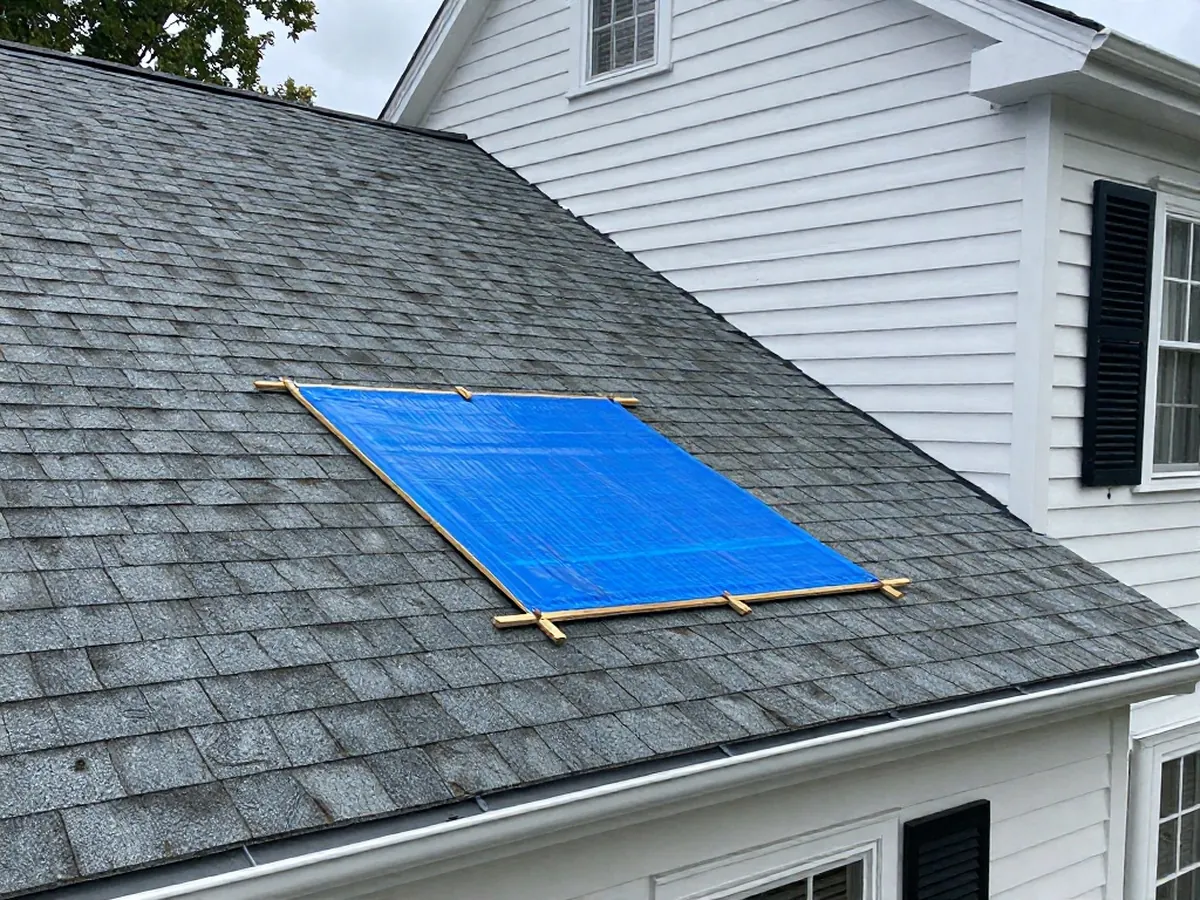
In the picture: a tarp, a limb and loose shingles
The scene shows the day-after view. A blue tarp covers the damaged corner, a limb lies across the lawn, and shingles that blew off sit in the grass. A tarp is a stopgap that keeps rain out until a repair can be done.
The picture is a rendering, not a photograph of a real house or storm.
Questions this job raises
How urgent is storm damage, on a 1-to-10 scale?
A wire down, a ceiling sagging with water or water at a light fixture makes storm damage an 8 to 10: get clear, then reach 911 or the utility. Missing shingles or bent metal with rain in the forecast is a 4 to 7, so call (908) 827-6709 soon. A few shingles that shifted without any leak are a 1 to 3: photograph them and watch the next rain.
Which pictures and papers help with a claim?
New Jersey's insurance department asks for pictures of all damaged property before anything is thrown away, and for damaged items to be kept until the insurer looks or says to discard them. It also asks for temporary repairs and every receipt. The adjuster comes from the insurer, and the contractor the insurer suggests is optional.
How far from a downed wire is far enough?
PSE&G says at least 30 feet, roughly two full pole spans, and it asks that every wire be treated as live, phone and cable lines included. FirstEnergy, the parent company of JCP&L, gives 30 feet for distribution lines and 100 feet for transmission lines. Report it to 911 or the utility.
What about a contractor who knocks on the door after a storm?
The asphalt roofing trade group says storm demand can draw contractors from far away, and urges a look at their standing, a written proposal and caution toward a contractor who wants money in advance. Federal rules let a buyer back out of many sales made at home within three days, but not a sale made to meet an emergency or a visit the owner requested for repairs.
Does storm repair cover the other five towns?
Yes. The contractor takes calls from Warren roofing, Watchung roofing, Green Brook roofing, Bridgewater roofing, Bernards roofing and Long Hill roofing. Call (908) 827-6709 once the wires are clear and say what the storm left behind.
Parts of the roof involved
What wind goes after first
FEMA's sloped-roof fact sheet says the roof border is frequently at risk from wind uplift, that eaves can become a major source of uplift failure, and that gable-end and rake vents are susceptible to wind-driven rain.
When shingles or underlayment blow off, the roof deck is open to water and debris. That is why a missing patch of shingles can turn into a ceiling stain after the next rain.
Paperwork, briefly
Insurance calls and door-knockers
The state insurance department's storm guide covers the report to your insurer, photos, temporary repairs and receipts. The federal cooling-off rule covers the three-day right to cancel some home sales. Both are written up, with links, on the hiring checklist.
Where this comes from (7)
- Asphalt Roofing Manufacturers Association, Assessing roof damage after Superstorm Sandy (7 Nov 2012)
- NJ Department of Banking and Insurance, Insurance claims after a storm
- Federal Trade Commission, Buyer's Remorse: The FTC's Cooling-Off Rule May Help
- PSE&G, Downed power lines
- FirstEnergy, Downed power lines
- New Jersey Weather and Climate Network, Remnants of Ida strike New Jersey
- FEMA, Fact Sheet 3.3.1: Roof Systems, Sloped Roofs (Mar 2022)
Checked 1 Nov 2026
Have these ready
Start with the street address, the room that shows water and a guess at the roof's age, then call (908) 827-6709. Renters can pass their photos to the owner, who arranges roof work.